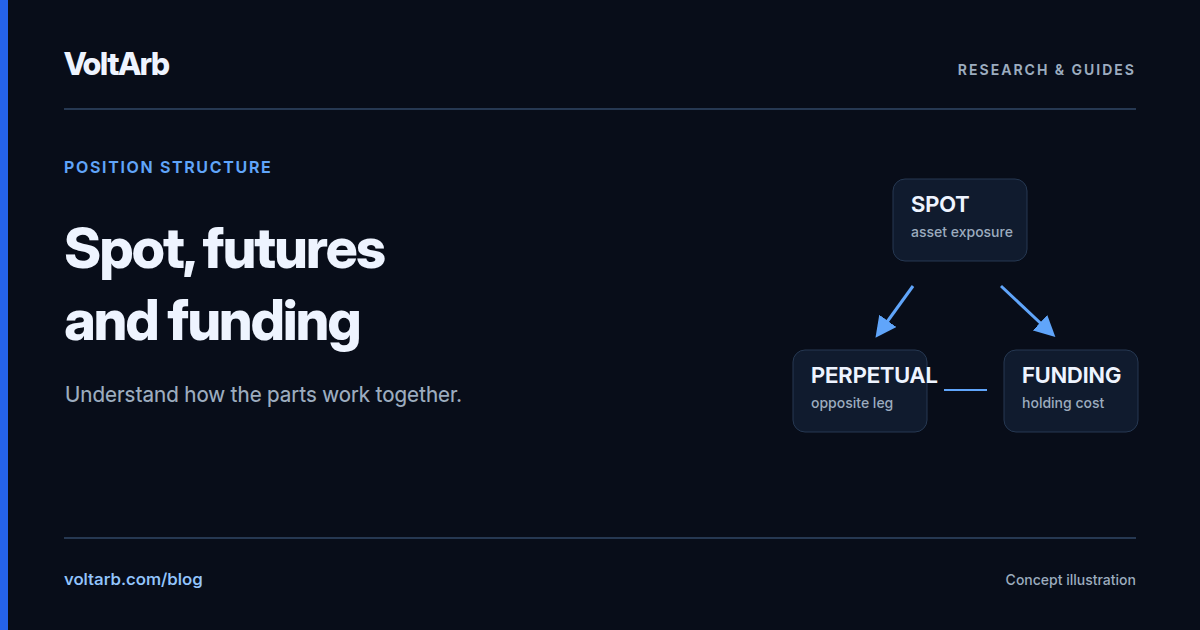
What an Arbitrage Bundle Is
In plain terms: a bundle is not “three unrelated signals” — it is one trade from two (or more) parts. Example: buy the coin on spot and short the perpetual futures at the same time. If the coin rises, spot wins and the short loses; if it falls, the opposite. Directional risk mostly cancels; what remains is the price gap and/or funding.
Each leg alone looks like a normal long or short bet. Together they should neutralize most price movement. What remains is the intended return: basis convergence (spot vs futures), a funding-rate gap, or both.
Open accounts early and complete KYC. Links go to signup / invite pages. This is not an endorsement of any venue — verify availability in your country.
A bundle answers “what will all legs earn together?”, not “where is the highest rate?”. The foundation is covered in the hedging arbitrage guide.
The Three Economic Legs
Two orders can create three sources of P&L. Keep them separate, or attractive funding can hide an expensive entry.
Difference between the spot fill and futures fill when both legs open.
Periodic transfers paid or received while the perpetual leg is open.
The spread remaining when you unwind; convergence is not guaranteed.
The rate is only one component. The funding rate guide explains payment direction, interval and receiving side.
Net Profit: A Complete $5,000 Example
The future trades 0.42% above spot. You buy $5,000 of spot and simultaneously short $5,000 of futures. After four settlements, the basis narrows to 0.10%.
Do not treat future rates as fixed. Exchanges recalculate funding, so later payments may shrink or reverse. The scenario should remain acceptable even if future funding income falls to zero.
The Spot–Futures Bundle
The classic cash-and-carry bundle buys the asset on spot and sells the richer future. Token quantity should match across both legs, not merely margin deposited. Then spot movement is roughly offset by the short.
A perpetual has no guaranteed convergence date. Define the exit in advance: target basis, maximum holding time or funding deterioration. A dated future converges toward spot at expiry, but adds calendar risk.
Spot is available, the short has sufficient margin, both legs are liquid at your size, and expected basis return stays positive after costs.
The Funding Differential Bundle
A futures-to-futures bundle opens a long on one exchange and an equal short on another. The goal is to receive the better payment on one side and pay less on the other while keeping delta near zero.
But $3.25 is not net profit: opening and closing may cost more. Venue selection is covered in the comparison of Binance, Bybit and OKX.
Matching tickers can use different indices, contract sizes, intervals and rate caps. Verify both exchanges’ specifications.
Execution Order and Slippage
A bundle becomes hedged only after both legs fill. Between the first and second trade, directional exposure remains. In a fast market, a one-second delay can erase expected income.
Confirm balances and margin, estimate both executable prices, open the less liquid leg with a controlled order, then hedge the filled quantity on the more liquid venue. After a partial fill, hedge the actual fill, not the original size.
A market order gives speed; a limit order gives a price boundary. Both require modeling slippage from book depth, not the top quote.
Set a maximum leg mismatch. If breached, stop opening and reduce the excess position.
Risks the Hedge Does Not Remove
Delta neutrality reduces price risk; it does not make the trade risk-free. Liquidation, basis expansion, venue failure and immobile collateral remain.
A losing futures leg may liquidate while an offsetting gain sits elsewhere.
The spread can widen before convergence, increasing margin demand.
Withdrawals may pause and one venue may become unreachable during an unwind.
Leverage reduces posted margin, not fees or notional risk. Treat the 5x leverage rule as a ceiling, not a target.
How to Evaluate Bundles in a Scanner
The workflow begins not with maximum funding but with executability. Liquidity, contract compatibility and position availability must pass before returns are compared.
Services may produce different estimates because of refresh frequency, order-book sources and fee models. Compare tools by calculation transparency and verify critical figures on the exchanges.
Use the scanner to shortlist candidates, not as a promise. Refresh both books and recalculate net profit before ordering.
Pre-Trade Bundle Checklist
Define whether return comes from basis, funding or both.
Match token quantities and use executable depth.
Include entry, exit, funding, borrow, slippage and transfers.
Set target basis, time limit and emergency unwind rules.
Recalculate the bundle with twice the expected slippage and zero future funding. If the safety margin disappears, reduce size or skip the trade.
A strong bundle is deliberately boring: legs are understood, risk is bounded, costs are counted and the exit is defined before entry. A high rate attracts attention, but only positive net profit after realistic execution makes the structure a trade.